
No-till sowing in dryland cereals: how to start without ploughing
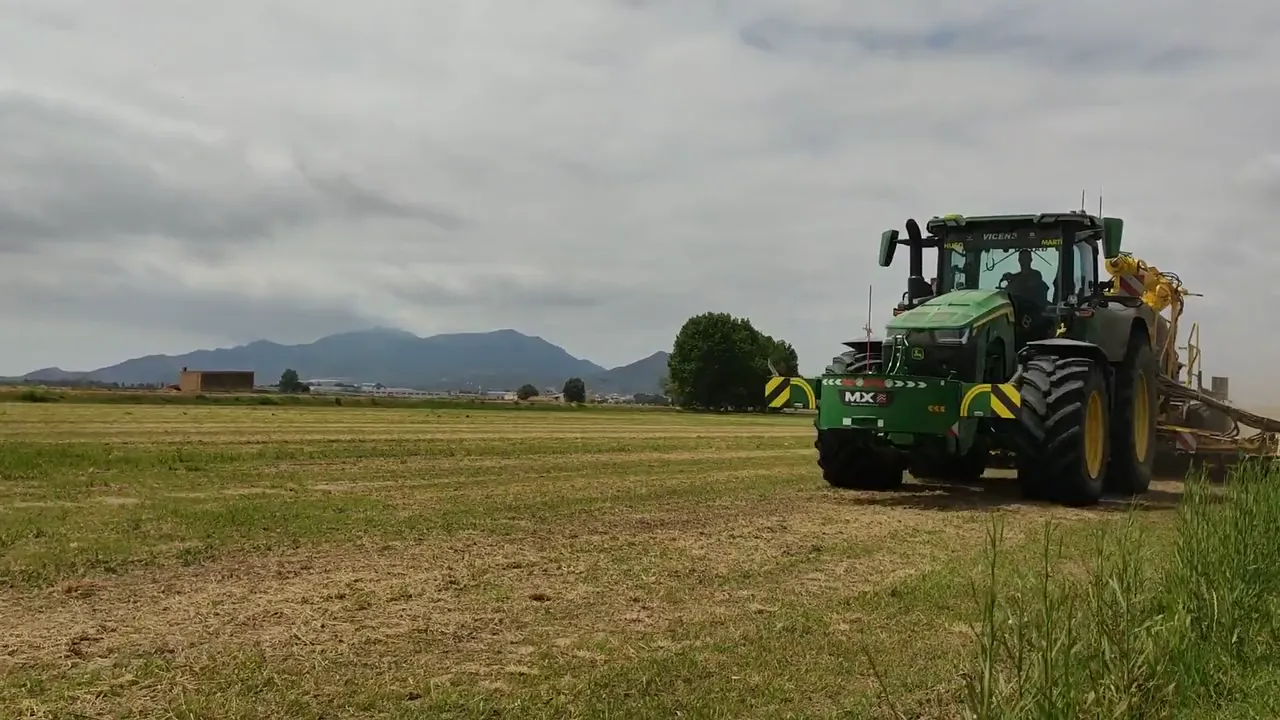
On many dryland farms the calendar repeats every year: plough, harrow, cultivate, sow. Each pass costs diesel, tractor hours and, above all, moisture. In a climate where water is the factor that most limits the harvest, tilling is opening the door for it to evaporate.
No-till sowing proposes something else: sowing into the soil without tilling. Xavier Vélez, founder of True Regenerative, has worked it since 2013 in cereals, oilseeds and legumes in La Rioja and Catalonia, within an experience of more than 2,000 hectares. In this guide we tell you what it is, what you need and where to start without gambling the harvest.
What no-till sowing actually is
No-till sowing is sowing into a soil that has not been tilled. The drill opens a narrow slot, places the seed at the right depth and closes it. The rest of the soil stays as it was, with the previous crop’s stubble on the surface.
It should not be confused with other practices. Cover crops (a crop sown to improve the soil, or spontaneous grass that does the same work) are a different tool, with their own management, and we cover them in other articles. Here we talk only about stopping tillage in order to sow the cereal.
Why it makes sense in dryland
Water: every tillage dries the soil
Each time the earth is turned, the loosened layer dries in the sun and the wind. Without tillage, the soil keeps the moisture it has better, and the stubble on the surface provides shade and slows evaporation. In dryland, a few millimetres more of water available at emergence can make the year.
Soil structure and life
The plough breaks aggregates, the channels of old roots and earthworm burrows. Without tillage, that network is kept and is built year after year. Rainwater enters better and less soil is lost to erosion, something that is very noticeable on sloping plots.
Fewer passes, lower costs
Going from three or four tillage passes to a single sowing pass reduces diesel, machinery wear and hours of work. It is not a promise of a specific saving, because it depends on each farm, but the calculation can be made with your own figures before you start.
What the evidence says
Let us be honest: stopping tillage does not guarantee a larger harvest. A meta-analysis with more than 5,000 observations across 50 crops (Pittelkow et al., 2015, Nature) found that no-till sowing, on average, produces somewhat less than conventional tillage. But that same work shows that in dry climates, when it is combined with keeping the stubble and with crop rotation, no-till equals or outperforms tillage.
The practical reading is clear: no-till sowing works better in dryland than under irrigation, and it works as a system, not as a stand-alone operation. If you only take the plough away and leave everything else the same, the results are usually worse.
Source: Pittelkow, C. M., Liang, X., Linquist, B. A., et al. (2015). Productivity limits and potentials of the principles of conservation agriculture. Nature, 517, 365-368. https://doi.org/10.1038/nature13809
The three pieces of the system
1. The drill
It is the key investment. A no-till drill has to cut the stubble, open the slot in firm soil and ensure good seed-to-soil contact. Before buying, you can hire one, contract the service from a neighbour or a cooperative, or try it on a plot.
2. The stubble
The previous crop’s stubble protects the soil and feeds the life in it. That is why it is not burned or removed in full. What matters is that it is well spread: if the combine leaves it in windrows, the drill works poorly and emergence comes out uneven.
3. The rotation
Repeating cereal on cereal builds up diseases, pests and the same weeds. Alternating cereal with a legume (vetch, pea, bitter vetch, lentil) or with an oilseed (rapeseed, sunflower) breaks those cycles and, in the case of the legume, supplies nitrogen to the following crop.
Weeds: the real challenge
Without tillage, the weeds that used to be buried stay on the surface. It is the point that most worries people at the start and the one that most has to be planned. The tools that help most are:
- Crop rotation, to change sowing dates and not always favour the same species.
- Delaying sowing by a few days when the year allows it, so that the weeds can emerge before you sow.
- Crop density and vigour, because a cereal that closes quickly leaves less room.
- Watching which weeds come up: bioindicator plants say a great deal about the state of the soil.
The aim is to depend less and less on herbicides, with a plan that is adjusted each season.
Common mistakes when starting
- Changing the whole farm in the first year. It is better to start with one or two plots and compare them with the tilled ones.
- Starting on a compacted soil. If there is a plough pan, it has to be resolved first; a soil analysis and some field tests help you decide.
- Sowing when the soil is too wet. The slot smears, does not close well and the seed is left poorly placed.
- Giving up in the second year. The soil takes several seasons to reorganise without tillage. The first years are a transition.
- Taking the plough away and changing nothing else. Without stubble and without rotation, no-till sowing loses much of its advantage.
How to know if it is going well
- Rainwater infiltrates faster and there are fewer puddles and less runoff.
- More earthworms and burrows appear in the top centimetres.
- The soil stays cooler and moister under the stubble.
- Emergence is even and the harvest holds or improves over the years.
Recording these data season after season lets you decide with your own numbers, not with opinions.
No-till sowing and autonomy
Stopping tillage is also stopping dependence: on so much diesel, on so many passes and, over time, on some of the inputs bought in. If you also make your own fertility in a biofactory on the farm, the system gains even more autonomy. That is the idea behind all our work: an autonomous farmer, not a dependent one.
Frequently asked questions about no-till sowing in cereal
Are no-till sowing and cover crops the same thing?
No. No-till sowing is sowing the crop into a soil that has not been tilled. Cover crops are another practice, with their own management: keeping sown or spontaneous vegetation to protect and feed the soil. On a farm they can coexist, but they are decided and managed separately.
Which crops can it be done in?
In the usual winter cereals of dryland farming, such as wheat, barley or oats, and also in the legumes and oilseeds that enter the rotation. We have worked it in those three groups of crops.
Do I have to buy a no-till drill?
To start, not necessarily. You can hire one, contract the service from a neighbour or a cooperative and try it on one or two plots before investing.
When do you notice the changes?
It depends on each soil and each year. The soil needs several seasons to reorganise without tillage, so it is worth recording the data of each plot and comparing them with those of the tilled plots.
How do I know if my soil is ready?
Look first at whether there is compaction or a plough pan. A well-interpreted chemical analysis (here is how to interpret a soil analysis), some field tests of soil health and watching the weeds that come up give a good basis for deciding.
How we accompany you
At True Regenerative we start with a diagnosis of the farm: soil, water, crops, machinery and people. With that diagnosis we design with you the plan for the transition to no-till sowing, plot by plot, with its rotation and its weed plan; we put it into practice at your side in the field and we train your team until they can carry it autonomously. Measurements (analyses, infiltration, earthworms) are a support to check how it is going and to adjust each season. This is the way of working we have applied for years across very different crops, soils and managements. We work from La Palma de Cervelló (Barcelona) throughout Catalonia, the rest of Spain and beyond; see how we work regenerative agriculture in Catalonia and our crops page.
For soil and covers, also read Soil, cover crops in woody plantations and the True Regenerative App (it orients in the field; it does not diagnose).
Si eres una empresa con fincas proveedoras de cereal y quieres acompañar su transición, visita For companies. Si tienes una finca de secano y quieres dejar de labrar, cuéntanos tu caso.
Be the one who does it.
Sources
- Pittelkow, C. M., Liang, X., Linquist, B. A., et al. (2015). Productivity limits and potentials of the principles of conservation agriculture. Nature, 517, 365-368. https://doi.org/10.1038/nature13809
Prefer to talk?
Book 30 minutes on Google Meet and let’s talk about your farm.
Book a first call (30 min)